

A Low Ebb
Fiction by Joseph Clegg

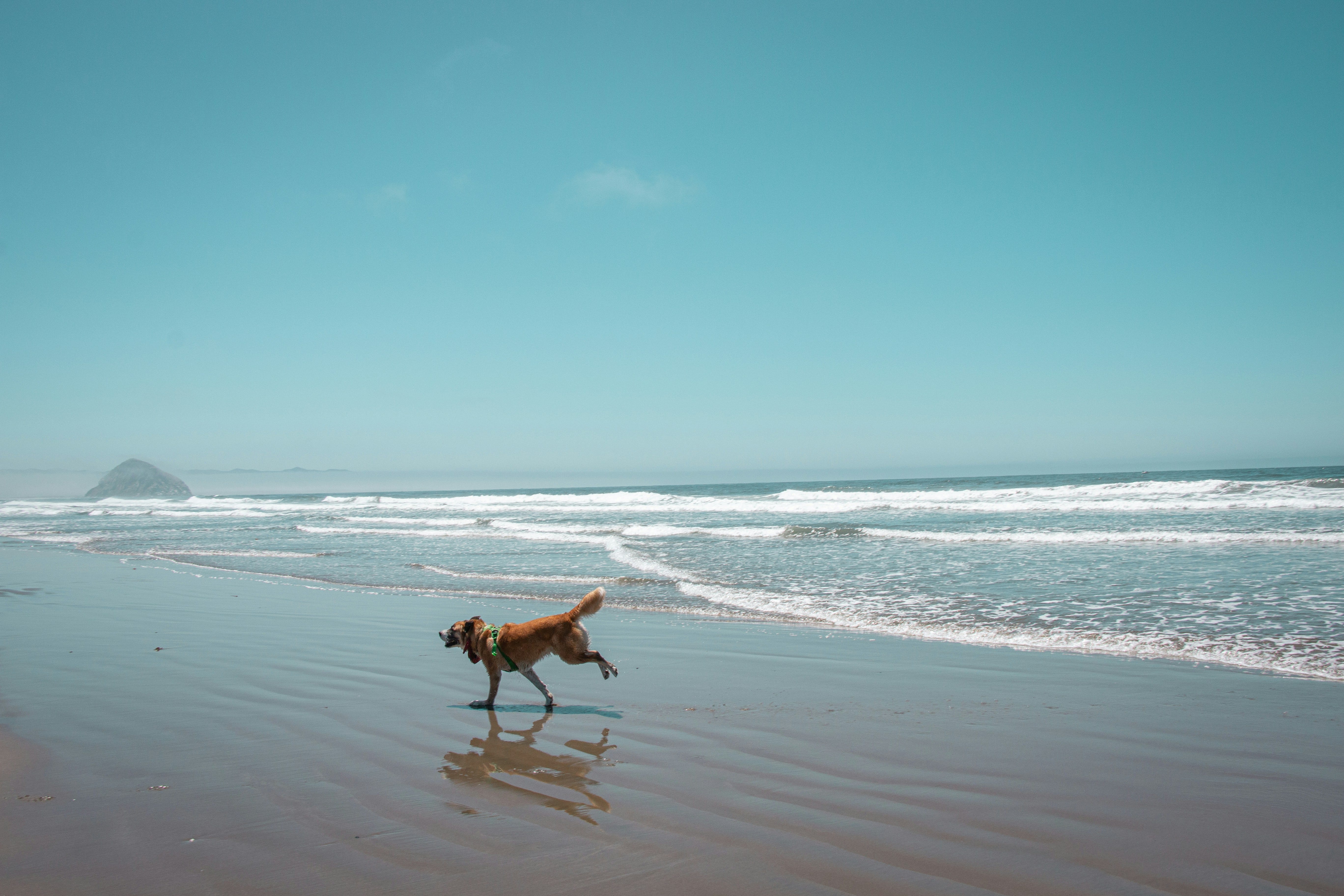
When Daryl got home from his shift Marley was out on the shoreline, doing her mid- afternoon stretches: a series of decisive motions, invisible pressure exuding from her hands, pushing back the water, parting the fussy waves. Her nine-month baby belly, Daryl noticed, caught her off balance now and then. Rather than interrupt for, as Marley might put it, precisely no reason, Daryl went straight inside and dumped the paper bags from Checkpoint Tandoori on the living room table. Rotor had sprinted in from the back garden and was headbutting the settee and chomping a shoe. Daryl tossed a beef naan into his bowl; as Rotor tore it up, Daryl found it hard to tell where floppy oily bread ended and folds of dog jowl began.
Marley entered, noiseless in fluffy hellcat slippers. Rotor waddled over to lick her sandy ankles.
“Have you seen the state of the tide?” she asked. “It’s gone way out.”
“Cos you was doing your Moses routine, that’s why.”
Marley took a seat and peeled the cardboard lid off a chicken bhuna, a basmati rice, an egg roll.
“Seriously,” she said. “I can’t remember ever seeing it out so far.”
“It’s just at a low ebb,” replied Daryl. “The work of our friend gravitational alignment. Don’t take it as an omen.”
“Alright. But if this baby comes out hooved, you owe your gal a pint.”
#
There were tasks awaiting Daryl in the back garden that afternoon, but he blitzed them off no problem. Applied a lick of light blue to the doorframe. Filled the hole Rotor had dug under the fence. Showed the lawnmower who’s boss. He was rewarding himself with a Carlsberg by the pond when Marley came outside. He called to her not to touch the still wet paint. Gulls were making an obscene racket over the rooftops and he could hardly hear her when she said, “It’s still going out.”
“What? The tide is?”
“Yeah. It’s miles away now.”
Daryl took a sip of lager.
“That’s a mighty low ebb, eh,” he said, sensing it wouldn’t quite satisfy her.
“This is not normal, Daryl. It’s draining away. Like someone took the plug out.”
“And who’d go and do a stupid thing like that?”
“Shut up. Come and see.”
They’d been left on a castle whose moat had run dry. Soft yellow sand gave way to wet sand gave way to glistening mud and grit, webs of seaweed, great clumps of polystyrene. Gulls dived at the stinking remains of stranded fish. Daryl put on his glasses: only just visible was a thin streak of blue ink, underlining the horizon.
“I thought sea levels are supposed to be rising,” was all he could think to say.
Course, everyone in the village knew the tide might one day come in too far. Daryl himself, around the time Marley’s bump started showing, had got a few of these midnight biblical visions: water swelling up cobbled alleyways, swamping low-lying plains, dragging the rusty rooster off the church spire. Whenever his imagination did that, he came back with his trusted mantra: “Show me the probables, mate, not the possibles.” But what was happening here didn’t seem to be either.
He and Marley arranged two chairs on the front step and sat to watch the show. How else were they going to pass time? Rotor scented the air, whining like he wanted to be let off-lead for a swim. Already, small teams of people had struck out to explore this alien new ground, wearing inflatable rings or wetsuits or carting life rafts. Water recedes before a tidal wave, Daryl once heard on the radio, so maybe flotation devices were a good shout. In any case, the sea showed no sign of flowing back towards land.
“It’s happening all down the east coast,” Marley read aloud, phone hand rested on her bump. “Huge swells leaving large parts of the seabed dry. Doesn’t seem to be stopping, just goes further and further out.”
“It has to stop. It has to come back. The sea can’t just decide sorry lads, fucking off now. Can it?” Daryl added: “We need it.”
His mind, scouting out ever more improbable probables, went back to that morning’s shift: to the agitated old bloke who’d arrived, mid-rant, on the eleven o’clock train, saying he was Larry and he had a message. Tempted as Daryl was to look back and think well, maybe this Larry was warning us, when it came down to it he was not some troubled oracle foretelling the end of times, just a man trying to get off a train via the wrong set of doors. The only message Larry brought was criticism—valid, to be fair—of the weekend timetable alteration. He also had an off-putting habit of chanting along with security announcements. It was a calm morning all down the coast, autumn-soft and overcast. Daryl had been working the ticket barriers when he got called over to assist Larry down to the platform. As the station staff chaperoned him, their arms round his shoulders, a British Transport Police slogan had cackled from Larry’s mouth. We’ll sort it! See it, say it, sorted.
“My parents are absolutely flipping out about this,” Marley said, giving the horizon side-eye as she looked up from her phone. “I better go call them. Then I’ve got to sleep.”
“Yeah, yeah, rest up. It will all be back to normal tomorrow morning.”
“Well, as long as hospitals are still running.”
“Don’t worry about that. We’ll sort it, Marley. Shout if you need anything.”
As the sky turned brown, Daryl flipped between scanning the beach and doom-scrolling news updates, amateur theories, highway disruption alerts, their house insurance policy. An emergency monitoring station had been set up to detect suspicious or unexplained activity across the exposed seabed. The army had been mobilised to keep order at the country’s largest container port. Thames, Humber, Tees, Tyne estuaries had delta’d and run to mud. Hundreds of vessels big and small lay on their sides, laughably beached.
A silhouette approached down the pavement through melted caramel haze. Gradually the blur subsided: it was Larry, the bloke from the train, sporting a bucket hat and carrying a gull. (Daryl realised only then that he hadn’t heard a birdcall for hours.) The duo came to a stop by his front gate, the bird giving Daryl a thorough once-over while Larry’s gaze wandered elsewhere. Neither of them blinked regularly.
“Unusual choice of pet,” Daryl said, after long enough of this.
“Broken wing,” Larry replied, offhand. “You’ve seen Doggerland?”
Larry gestured behind him at what used to be the North Sea, a backward sweep from shoulder to hip, as though bowling blind at a wicket.
“Is that what we’re calling it?” Daryl asked. “Well, my dog preferred the sea.”
“No, no. Doggerland was a place. From long ago, before the sea was ever there. Nothing new at all.”
“Look, can I help you, mate? Where exactly do you want to get to?”
Larry smiled: a face that might be described as charmed, one way or another.
“Seriously, Larry. You seem pretty chuffed about this rise of Doggyland stuff. It don’t bode so well if you ask me.”
“Then why…” Larry pronounced the H in why. “Why not just fill her back up?”
“Pardon?”
“You heard me. Refill the sea. See it, say it, sorted.”
A splashing down the road. Daryl turned round and saw a jet of water arcing over a row of cars. Then further on, another, glinting under ochre streetlights.
“What the heck have you been telling these people?” he muttered.
The gull croaked. Larry stroked its beak, tipped his hat and went on his way. The sound of water gushing then spattering on hard earth built and built in Daryl’s ears. He ran down the side of his house and unravelled the hose. One day he would tell his daughter all about this.
#
Standing in the street at midnight, aiming a constant spout of water at an empty beach, his neighbours doing the same right along the front: it was actually pretty good craic. Cosy jumpers got stretched over tummies; beers got passed hand to hand; fun, roughly speaking, got had. A bloke a few doors down who Daryl knew by his chubby labrador raised up a bit of a singsong, self-conscious at first, but before long fully animated, as the men of the street united for a chorus of “We Are The Champions”. Daryl, hoping Marley wouldn’t be woken by the racket, kept his own volume down.
By quarter to one, Neil Arkwright from no. 234 had elected himself head of “the operation”. As he patrolled from yard to yard on his souped-up moped, he was insistent that this was only its very early stage. Arkwright had it all worked out in his head: the boys on the front would continue to take turns on hosepipe duty, to be relieved later in the night by army water cannon and air drops. Meanwhile, a separate contingent was departing from The King’s Shilling pub to secure what Arkwright referred to as the maritime perimeter. Perimeter, Daryl thought silently, meant the border.
“Sorry, Neil,” he called out across the pavement. “But that’s suicidal. We’ve got to stop them. We can’t have a bunch of pissheads going and getting lost out there. Who knows when the sea’ll smash back in?”
Arkwright revved his engine, as though Daryl was simply wasting his time. Probably a fair point as well: Daryl wasn’t exactly volunteering to try and persuade this ad hoc regiment away from its charted course. Arkwright himself, even in his belligerent heyday, would not have stood a much better chance.
“Back to wetting the flowerbeds, son.” Arkwright wheeled up the kerb and placed a leather-gripped hand over the muzzle of Daryl’s hose. “Leave those boys to it.”
#
An hour and a half later, when Marley appeared in the front doorway, shadow backed by hall light, there was still no sign of Arkwright’s promised army. On spotting his missus, Daryl silenced the jet, lowered the hose. In her red bathrobe, Marley’s belly was boiling with life, her face stunned to perplexity. A hellcat slipper was missing from one of her feet. Without having to ask Daryl what the hell he was doing, she asked him just that.
So, he caught her up with the last goings-on. How a shaman bird fancier with zero practical understanding of doors had spoken of an undrowned country and had counselled that, by human intervention, the ocean might be rebirthed. And how this had seemed to make sense at the time, but how Neil bloody Arkwright had obviously then got involved and now some tanked-up lads had been sent out to face almost certain—
Marley broke in to say, “You’ve not heard Rotor kicking off, then.”
“Shit. Is he?”
Daryl strained to listen. Bloof. There it was, and again, from the back garden. Bloof-bloof.
“Oh gawd. He’s not been keeping you up, has he? I genuinely thought he was snoozing.”
“Doesn’t sound much like it to me.”
Traces of canine agitation were all over the living room. Daryl shook his head as he surveyed the havoc: no way could this have happened without him hearing, he was literally stood just outside the window. Among other things, the dog’s claws had burst the beanbag, launching grey polystyrene buckshot through rug and carpet. A doll they bought to welcome the little one now lacked its nose.
Marley and Daryl followed a trail of chewed candles to the back door. As Daryl pulled it inwards, he imagined it leading to another living room: the normal, unfucked one they had left behind that afternoon, with salty breeze buffeting its curtains and swooshing wave sounds that never ceased. Instead, their ears were subjected to an abrasive howl. Rotor hadn’t acted up like this since he was a puppy. Sharply, Daryl called his name, but it accomplished nothing. The dog’s snout was jerked upwards, his front paws lifting off the flagstones with every yelp. In the now cloudless sky, two moons hung like crimson cufflinks.
Daryl held in his scream. Mouthing incomplete words, Marley pointed a finger at the red globe poised above their lilac tree. This was the new arrival, Daryl realised on studying it, without the familiar patchy scars of their regular moon. The two spheres loomed side by side, as if separated by only a touching distance. Size-wise, the newcomer had a slight edge.
Without thinking, Daryl brought out his phone. Marley had hers out too, so that screen light cocooned them, keeping the satanic glow at bay. Daryl refreshed all seven news tabs: seven versions of the same hoursold headline, still banging on about the bloody North Sea.
Marley pressed her phone into his hand. It was open to Wikipedia.
“Oh god. Read this.”
This article is about the planet. For the deity, see Mars (mythology). Mars is the second largest of the Earth’s natural satellites. It was previously the fourth, and briefly the third, planet from the Sun.
“No way. They’re taking the piss.” Daryl raised his eyes far enough to meet Marley’s, careful not to let those twin demons enter his vision again. “Wikipedia, yeah? Anyone can rewrite this rubbish.”
“What if it’s true, though? It explains the tide.”
“Not sure it does. The tide’s getting pulled away from us, right? That way. But the moon and… Both the moons are over here, so.”
“Yeah, but have you thought about what might have happened on the other side?”
She gestured again to the phone. Daryl scrolled, his thumb jerking text up and down the screen. “We Are The Champions” still boomed round his head.
“You have to be ripping me,” he said. “Venus is at it as well?”
Marley lowered herself into a crouch. Daryl, too, lurched towards the ground—uncoordinated, flailing.
“What? Marley, are you…?”
“No, no,” she said. “I’m fine.”
She drew Rotor in, nuzzled him against her belly. The dog’s whimpering continued for a moment, then, perhaps feeling the reassuring kick of new life against his bristly coat, he quieted. He was always so gentle with little kids. He didn’t bounce them, he only ever nibbled treats out of their hands—a perfect friend for a little girl who might decide to be born any moment now.
“So you see the scale of it, don’t you?” Marley stretched her one bare foot towards the grass, holding an arm out the other way for equilibrium. “Me and this baby and this dog, you and your shaman and your hosepipe. You see what we’re up against?”
Joseph Clegg writes stories, poetry, some things that might be both and many that are probably neither. He is an enthusiastic co-organiser of two literary critique groups in Amsterdam and a regular contributor to BRICK music magazine.
Website: www.cleggjjg.com.
Feels like an appropriate metaphor for a world that is in such unbalanced flux that we all can’t get our balance…. And all we can do is tear up the furniture or point our tiny hoses at the long lost sea…